更新时间:2025-12-24 15:54:55 点击:57599
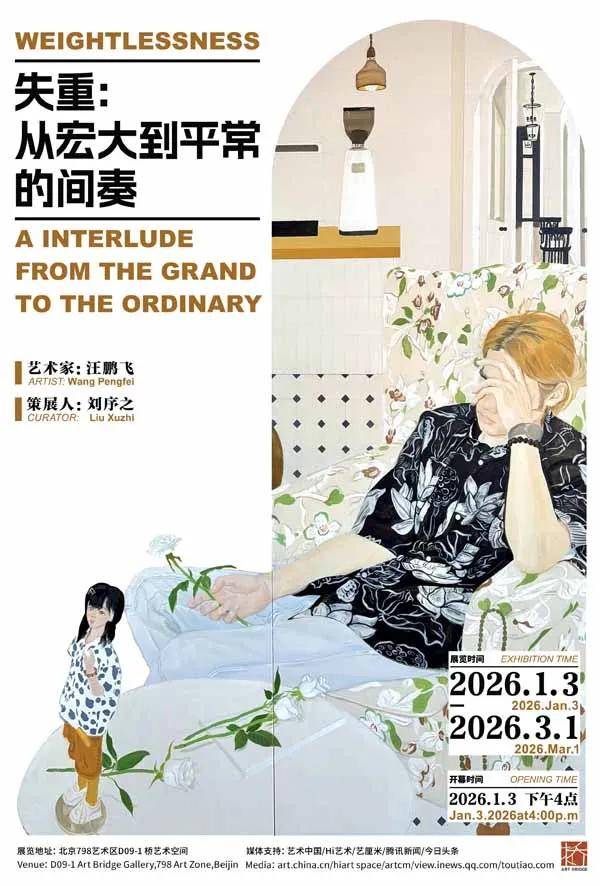
《 失重:从宏大到平常的间奏 》
WEIGHTLESSNESS
A INTERLUDE FROM THE GRAND TO THE ORDINARY
艺术家:汪鹏飞
Artist: Wang Pengfei
策展人:刘序之
Curator: Liu Xuzhi
主办单位:桥艺术空间
Organizer:Art Bridge Gallery
展览时间:2026年1月3日——2026年3月1日
Exhibition Date:Jan.3,2026 - Mar.1,2026
开幕时间:2026年1月3日 下午4:00
Opening time:Jan.3.2026 at4:00p.m
Venue: D09-1 Art Bridge Gallery,798 Art Zone,Beijing
媒体支持:艺术中国/Hi艺术/艺厘米/腾讯新闻/今日头条/新华网/中国网/中国美术报/人民艺术
Media:art.china,cn/hiartspace/artcm/view.inews.qq.com/toutiao.com/Xinhuanet/China.com/China Art News/People Art
序
莱比锡剧作家理查德·瓦格纳于19世纪40年代创作了一部关于冲突与代价的歌剧《唐怀瑟与瓦尔特堡的歌赛》。当演出至第一幕的尾声,吟游诗人唐怀瑟离开蔓延着血色熔岩、象征欲望的岩洞,踏上通往瓦尔特堡的山道,远处传来朝圣者的合唱,清晨的浓雾随着日升沉降,而维纳斯的魅惑歌声仍从地底的深渊里冒出:来我这里,跟着我,唐怀瑟,回来……大幕随之缓缓落下,间奏响起,又骤然结束,大幕急速升起,唐怀瑟仍伫立舞台中央,但已置身瓦尔特堡透着冷白天光的赛歌大厅!
对于观众而言,这是一种不违背预期、不令人起疑,却又极为失真的体验:唐怀瑟从一个时空抵达另一个时空——只在灯光明灭、音乐起落、帷幕升降之间。
本次个展中的汪鹏飞正如舞台上的唐怀瑟一样,已抵达另一片天地,至于如何抵达的,不得而知。
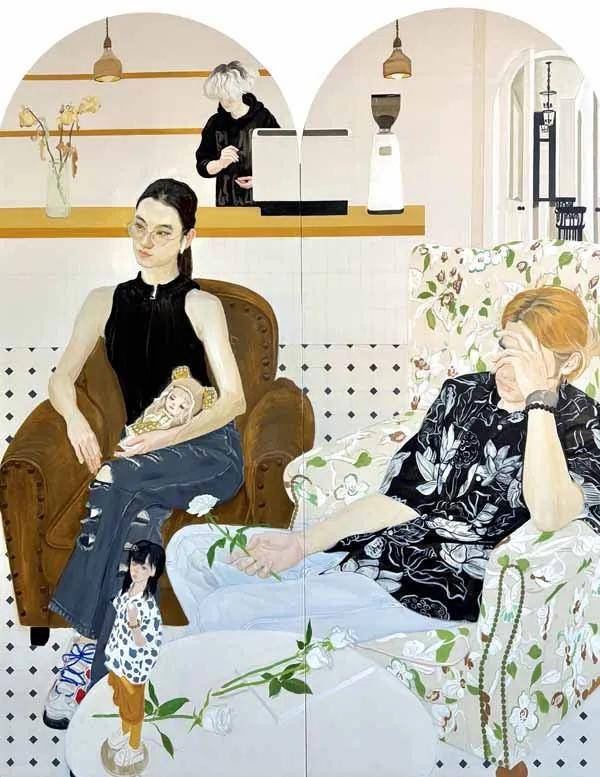
▲《花季》
布面油画
200×160cm
2025年
羁旅归途
艺术的追随者们早已对一类事情习以为常,即习惯了琢磨艺术家的想法和技法,抽丝剥茧般梳理艺术作品的来龙去脉,将艺术探索视为一条迂回曲折或笔直坦荡的道路,艺术的创作者们在上面一步一个脚印的前行,而他们则不断的为其注明坐标,仿佛可以知晓每一个脚印的来由和去向。这样的认知未免太过傲慢,难怪库尔贝曾言:我要以我的作品惊吓有产阶级。本次展出的汪鹏飞近作也似乎不断提醒着我们:有的人热衷于为艺术迷宫绘制地图,而我只是在这座迷宫里闲逛。
今时的我恰好逛到了某处,遇见了今时的你们。
也许人类被设计了一条不可被篡改的基因代码:初生之人定将远行,而行远之人定会迷恋出发的地方。汪鹏飞作为一个远行者,今时将目光聚焦或失焦在中世纪的绘画上——那是油画的出发地。

▲《惊愕》
布面油画
200×160cm
2025年
在他的画中,类似湿壁画常用的纯粹青蓝、橙橘颜色被巨大的白色包裹在一个干净、质地透明的空间里,却用以刻画不经筛选的对象与场景,试着以一种“去抉择化”的方式来实现他所追求的“日常”。值得注意的是,画中的对象与场景并无须经汪鹏飞“亲眼”所见,而是来自图像的图像——图像已浩浩荡荡的跻身日常的日常。
画面还时常被刻意制造成门窗的形状,像是他为自己准备的“紧急出口”,让人联想到古老教堂里的祭坛画边缘。但汪鹏飞并不考古,他所要的是让历史再次发生,或者说,今天发生的一切,至于明天,不也是历史吗?
“我想用最原初的精神与愿望来画当下的日常模样”是汪鹏飞的原话。
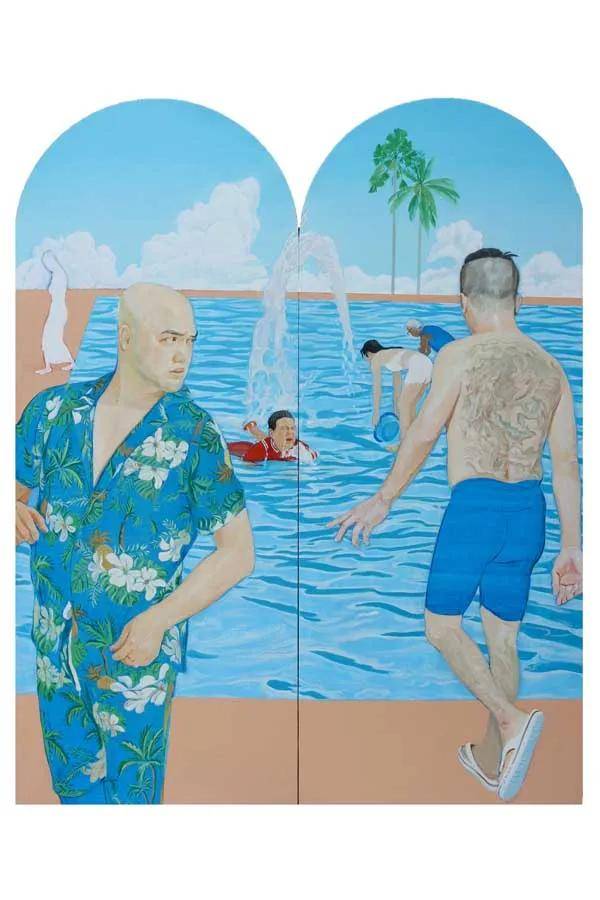
▲《大大的水花》
布面油画
200×160cm
2025年
轻盈自省
我去到汪鹏飞的画室的时候,墙上靠着一张未完成的大画,旁边的纸箱里装着一箱羽毛,汪鹏飞正尝试着将羽毛粘到画面厚重的颜料上,但效果似乎不理想,汪鹏飞自嘲:呵呵,搞得一地鸡毛!
汪鹏飞曾在文章里写道:“原本最期待有一间大画室,而且一定要带天窗,但当真的拥有了带天窗的大画室后,就再也没有画出满意的画来。”这段平实的表述里,至少隐藏了两条画家的自省:一是汪鹏飞隐约警觉物质基础并不能左右或者助力艺术创作,二是警觉“满意”并非恒定的标准,而是随着认知上下浮动、忽远忽近的岛屿。真正的画家怕是难以踩上彼岸的沙滩了。
同样令他警觉的,是他的成长时代与从艺经历。汪鹏飞成长、从艺在一个充斥着落后焦虑的时代,那是“沉重”得以生长的土壤,存在的危机感使分量被列为价值体系中重要的度量单位以抗衡艺术自古给人带来的愉悦,这也成为了汪鹏飞今时美学回溯的底色。
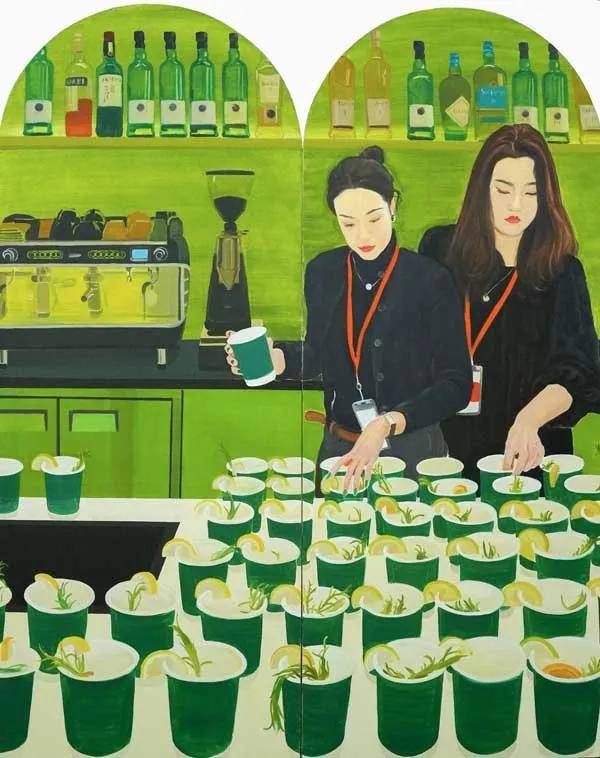
▲《开幕式》
布面油画
200×160cm
2024年
汪鹏飞先是在与进步、退步的较量中学会了看轻绘画与自己,哪怕仅是“看”轻。而后在悲剧与喜剧,牺牲与寻欢,英雄与丑角之间选择了平常,进而回到了平常,融入了平常。此时,“举重若轻”变得不再那么独特而可取,代之常以为习,作为他艺术里暂时的答案。
如果将汪鹏飞早先的作品视为泥土、砂砾、岩石,而本次个展呈现的更像是一片羽毛,我们已无暇争辩哪一批作品更能嵌入我们的记忆里,或是更能沐浴在未来的日光里呼吸,因为每一批作品都将成为过去的作品,而每一批过去的作品都将作为一个切片、一圈年轮,或一段链接上一幕与下一幕戏码的间奏(Bridge),期盼他一次次抵达彼岸。
刘序之
2025年12月于南宁
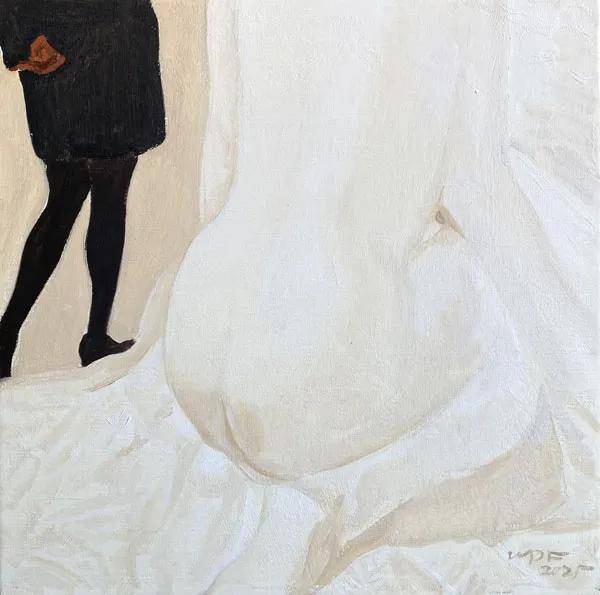
▲《凝望-2》
布面油画
35×35cm
2025年
Preface
In the 1840s, Leipzig-based dramatist Richard Wagner composed his opera Tannhäuser and the Song Contest at Wartburg, a work centered on conflict and its costs. Towards the end of Act I, the minstrel Tannhäuser departs the cavern of Venus—a realm of desire seething with crimson lava. As he ascends the mountain path toward Wartburg Castle, the chorus of pilgrims is heard echoing in the distance. The morning mist lifts with the rising sun, yet the alluring call of Venus still drifts from the abyss below: “Come to me, follow me, Tannhäuser, return…” The curtain slowly descends, an interlude sounds, and ends just as abruptly. Then the curtain rises swiftly, revealing Tannhäuser still standing at center stage, now bathed in the cool white daylight of the Wartburg song contest hall.
For the audience, this is an experience that neither violates expectation nor arouses suspicion, and yet it is profoundly disorienting: Tannhäuser journeys from one reality to another—in the mere flicker of lights, the swell and fade of music, the fall and rise of the curtain.
In this solo exhibition, Wang Pengfei, much like Tannhäuser on stage, has already arrived in another realm. How he got there remains a mystery.
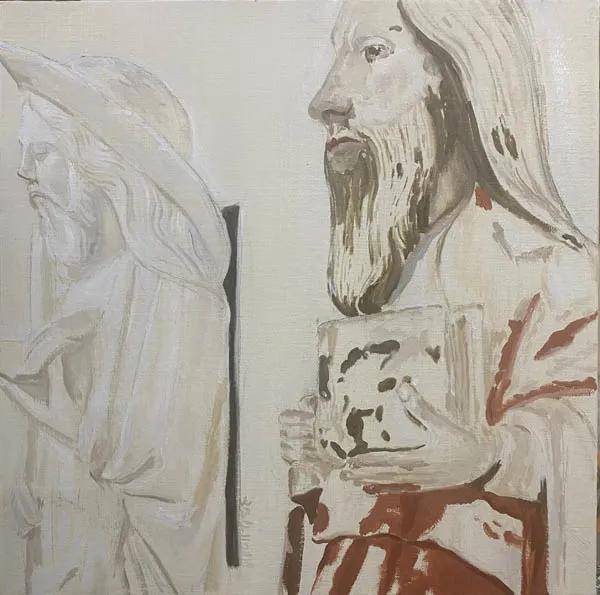
▲《凝望-1》
布面油画
35×35cm
2025年
Homeward Journey
Followers of art have long grown accustomed to a certain approach: they habitually dissect the artist’s ideas and techniques, trace the lineage and context of an artwork thread by thread, and treat artistic exploration as a path—winding or straight—on which the creator treads step by step. Observers, meanwhile, annotate the journey with coordinates, as if able to map the origin and destination of every footprint. Such perception may be unduly presumptuous—no wonder Courbet once declared: “I want to shock the bourgeoisie with my work.” The recent works by Wang Pengfei presented here seem to offer a similar reminder: some are eager to chart a map of art’s labyrinth, while I am merely wandering within it.
I happen to have wandered here, now, and met all of you here today.
Perhaps humans are encoded with an unalterable directive: the newly born shall journey far, and those who journey far shall grow haunted by the place from which they departed. Wang Pengfei, as such a traveler, now turns his gaze—now focused, now softly blurred—toward Medi painting: the very birthplace of oil painting itself.
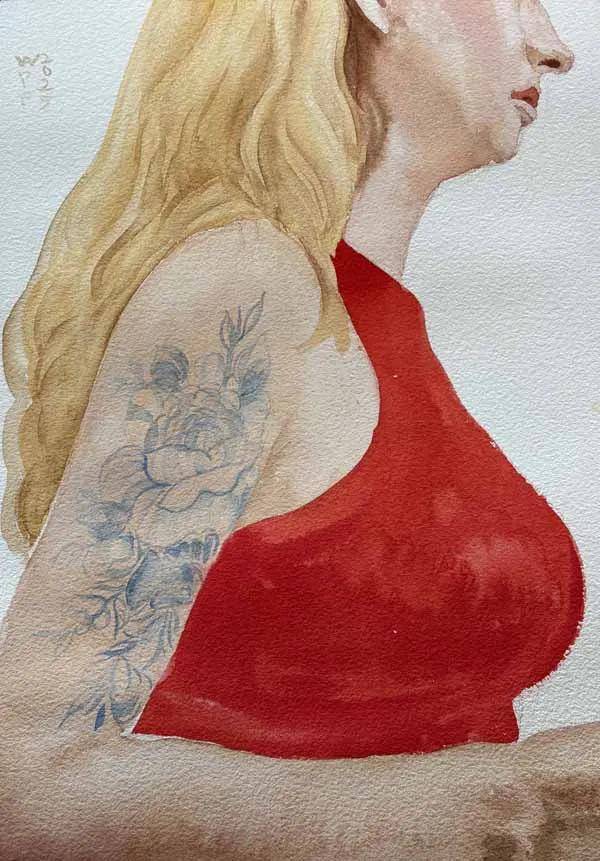
▲《有纹身的女孩儿》
水彩
36×26cm
2025年
In his works, pure blues and oranges reminiscent of fresco technique are enveloped by vast fields of white, held within a clean, translucent space. Yet these colors depict uncurated objects and scenes, as he seeks to render “the ordinary” through a method of de-selection. It is worth noting that what appears in these paintings need not have been witnessed firsthand by Wang Pengfei; they often come from images of images—pictures that have already surged into the everyday of the everyday.
The canvases are also often shaped deliberately like doors or windows, resembling “emergency exits” he has prepared for himself, evocative of the framed borders of altarpieces in ancient churches. But Wang Pengfei is not an archaeologist; what he wants is for history to occur again—or rather, to recognize that everything happening today is already history. After all, will tomorrow not be history as well?
“I want to paint the present-day ordinary through the most primordial spirit and desire,” Wang Pengfei has said.
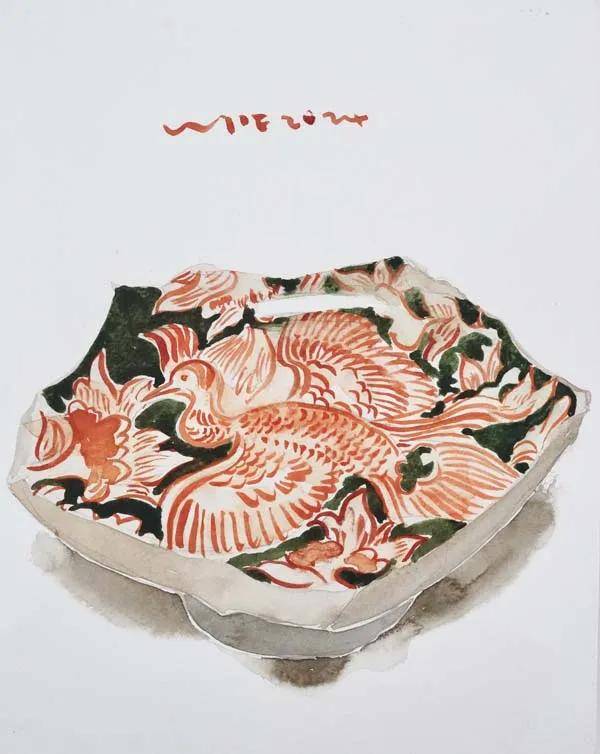
▲《瓷片-1》
水彩
19×24cm
2024年
Lightness and Introspection
When I visited Wang Pengfei’s studio, a large unfinished painting leaned against the wall. Nearby, a cardboard box was filled with feathers. Wang Pengfei was trying to fix them onto the thick paint of the canvas, but the result seemed unsatisfying. He laughed at himself: “Well, isn’t this a fine mess.”
Wang Pengfei once wrote: “What I most looked forward to was a large studio, and it had to have a skylight. But after I actually got a large studio with a skylight, I never painted a satisfactory work again.” This plain statement contains at least two layers of the artist’s self-reflection: first, a dawning awareness that material conditions cannot dictate or necessarily aid artistic creation; second, a wariness that “satisfaction” is no fixed standard, but an island that drifts closer or farther with the tides of understanding. A true painter may never quite reach that distant shore.
What also keeps him vigilant is the era of his growth and his artistic formation. Wang Pengfei came of age and began his practice in a time saturated with anxiety over perceived backwardness—a soil in which “heaviness” could take root. A sense of existential crisis elevated weight and gravitas into key measures of value, a counterweight to the pleasure art has traditionally offered. This became the implicit tone of Wang Pengfei’s present aesthetic return.
Wang Pengfei first learned, amid struggles between ideas of progress and regress, to regard painting—and himself—lightly, if only in perception. Then, between tragedy and comedy, sacrifice and revelry, hero and fool, he chose the ordinary, returned to it, merged with it. Here, “lifting heavy weight as though it were light” ceases to be a special virtue; instead, it becomes habitual practice, a provisional answer within his art.
Epilogue
If Wang Pengfei’s earlier works may be seen as soil, grit, and stone, this solo exhibition presents something closer to a feather. There is little use debating which body of work might embed itself more deeply in memory, or breathe more freely in future light—for every body of work will become the work of the past. And each past body of work will stand as a slice, a tree-ring, an interlude—a bridge between what came before and what follows—awaiting his next arrival on the other shore.
Liu Xuzhi
December 2025, Nanning
关于艺术家
About Artist

汪鹏飞
Wang Pengfei
安徽省歙县人。
2006年毕业于中央美术学院油画本科。
2016年毕业于中央美术学院油画系,获硕士学位。
现为广西艺术学院美术学院油画系第一工作室主任,硕士研究生导师。
一级美术师。
中国美术家协会会员,中国油画学会会员。
广西油画学会副会长。
个展
2008年
历史的回声——汪鹏飞个人作品展,北京时代美术馆
2016年
无声处——汪鹏飞油画作品展,北京798桥艺术空间
2017年
远去的风景——汪鹏飞油画作品展,无锡美术馆
2023年
苍——汪鹏飞个展,安徽徽州历史博物馆
2025年
看,这个世界——汪鹏飞的游走与记录,桂林井田艺术
重要参展:
2024年
第十四届全国美展油画展区进京作品。(文化旅游部,中国文联、中国美协)
2020年
可见之诗--第四届中国风景油画作品展,获学术奖。(中国油画学会)
百年圆梦---中国百家金陵画展(油画),获典藏奖。 (中国美术家协会)
2019年
第十三届全国美术作品展油画展。(文化旅游部,中国美协)
大路西行中国油画作品展,获学术奖。(中国油画学会)
第十二届中国艺术节全国优秀美术作品展。(文化旅游部)
2018年
可见之诗--第三届中国风景油画作品展,获优秀奖。(中国油画学会)
2012年
第五届中国北京国际美术双年展。(中国美术家协会)
2010年
研究与超越----第二届中国小幅油画展”获优秀奖。(中国油画学会)
2009年
第十一届全国美展油画展。(中国美术家协会)
第十一届全国美展综合材料绘画展。 (中国美术家协会)
2008年
第三届中国北京国际美术双年展。(中国美术家协会)
2007年
首届中国青年百人油画展,获优秀奖。(中国油画学会)
重要收藏:
中国美术馆、江苏美术馆、上海美术馆、安徽徽州历史博物馆、长沙李自建美术馆、中国油画学会。
Wang Pengfei
born in She County, Anhui Province.
Graduated from the Central Academy of Fine Arts with a bachelor's degree in Oil Painting in 2006.
Graduated from the Oil Painting Department of the Central Academy of Fine Arts with a master's degree in 2016.
Currently, he is the Director of the First Studio of the Oil Painting Department, Academy of Fine Arts, Guangxi Arts University, and a master's supervisor.
First-Class Artist.
Member of the China Artists Association and the China Oil Painting Society.
Vice President of the Guangxi Oil Painting Society.
Solo Exhibitions
2008
"Echoes of History - Wang Pengfei's Solo Exhibition",
Times Art Museum, Beijing.
2016
"In the Silence - Wang Pengfei's Oil Painting Exhibition"
Bridge Art Center, 798 Art Zone, Beijing.
2017
"Fading Landscapes - Wang Pengfei's Oil Painting Exhibition"
Wuxi Art Museum.
2023
"Cang - Wang Pengfei's Solo Exhibition"
Huizhou History Museum, Anhui.
2025
"Look, This World - Wang Pengfei's Wandering and Recording"
Jingtian Art, Guilin.
Important Group Exhibitions
2024
Works shortlisted for the Oil Painting Section of the 14th National Art Exhibition and exhibited in Beijing. (Ministry of Culture and Tourism, China Federation of Literary and Art Circles, China Artists Association)
2020
"Visible Poems - The 4th China Landscape Oil Painting Exhibition", won the Academic Award. (China Oil Painting Society)
"Century Dream Come True - China Hundred Schools Jinling Painting Exhibition (Oil Painting)", won the Collection Award. (China Artists Association)
2019
Oil Painting Section of the 13th National Art Exhibition. (Ministry of Culture and Tourism, China Artists Association)
"Westward Journey Along the Grand Road - China Oil Painting Exhibition", won the Academic Award. (China Oil Painting Society)
National Excellent Art Works Exhibition of the 12th China Art Festival. (Ministry of Culture and Tourism)
2018
"Visible Poems - The 3rd China Landscape Oil Painting Exhibition", won the Excellent Award. (China Oil Painting Society)
2012
The 5th China Beijing International Art Biennale. (China Artists Association)
2010
"Research and Transcendence - The 2nd China Small-Size Oil Painting Exhibition", won the Excellent Award. (China Oil Painting Society)
2009
Oil Painting Section of the 11th National Art Exhibition. (China Artists Association)
Comprehensive Materials Painting Section of the 11th National Art Exhibition. (China Artists Association)
2008
The 3rd China Beijing International Art Biennale. (China Artists Association)
2007
The 1st China Youth Hundred Oil Painting Exhibition, won the Excellent Award. (China Oil Painting Society)
Important Collections
National Art Museum of China, Jiangsu Art Museum, Shanghai Art Museum, Huizhou History Museum of Anhui, Li Zijian Art Museum of Changsha, China Oil Painting Society.